Portuguese Cheese10 Cheeses to Know and How to Eat Them
Portuguese cheese explained: Serra da Estrela, Azeitão, São Jorge, Nisa, Serpa and more, which are PDO, and how to eat soft amanteigado cheeses.
 By Mesa de Portugal Kitchen · Updated · 7 min read
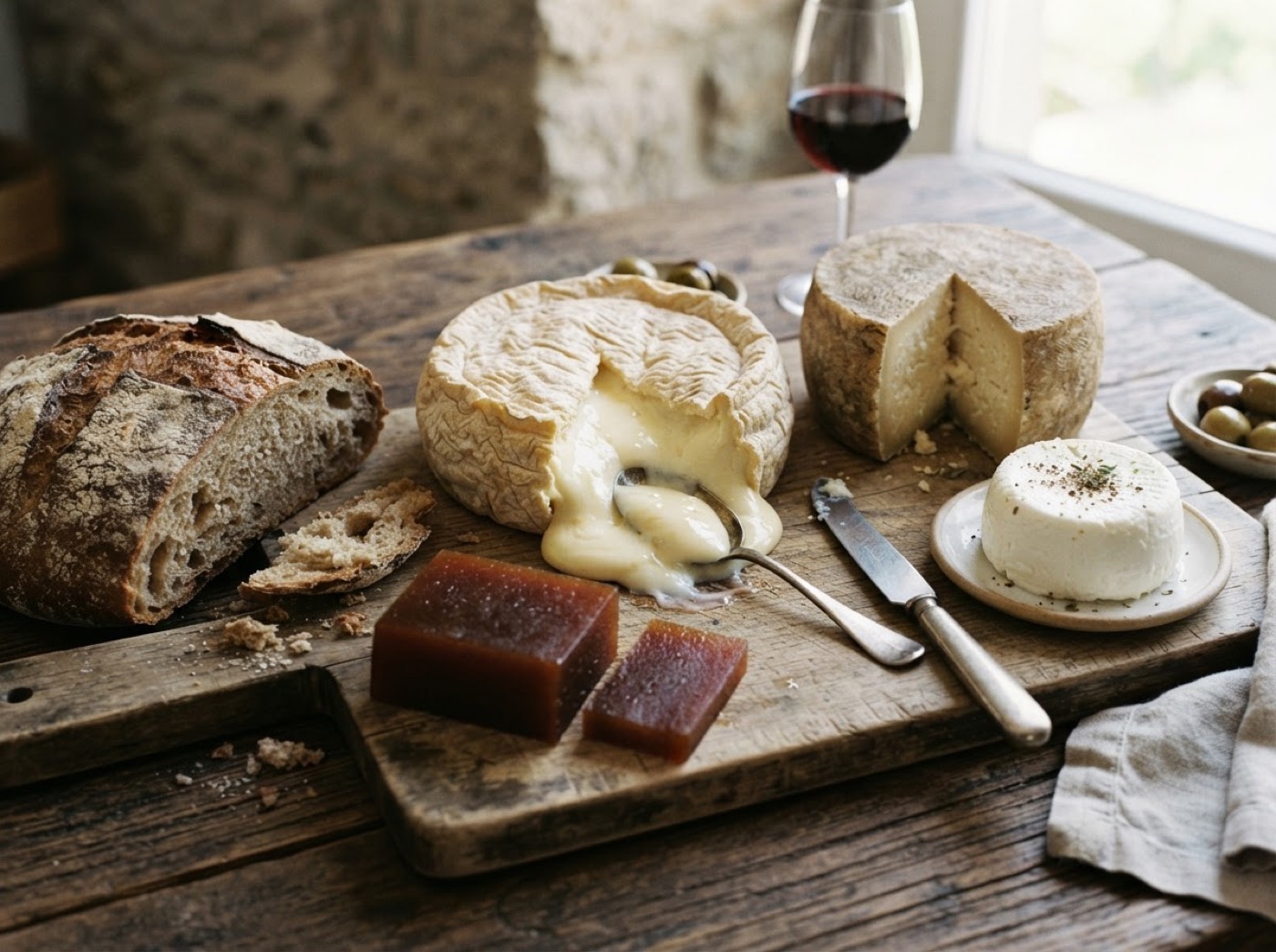
Portuguese cheese is mostly made from raw sheep's and goat's milk, and the best-known kinds are curdled with dried thistle flowers instead of animal rennet. That gives them a soft, buttery, slightly bitter and tangy character you won't find anywhere else. The famous names are Serra da Estrela, Azeitão, Serpa, Nisa, Évora and São Jorge, and most of them are protected as PDO (DOP in Portuguese).
Outside Portugal these cheeses are still hard to find, which makes them one of the great things to eat on a trip. Here are ten to know, then how to eat the soft ones properly.
What makes Portuguese cheese different?
Three things set it apart:
- Sheep's milk. Much of inland Portugal is dry grazing land better suited to sheep and goats than cows. Cow's milk cheese comes mainly from the Azores.
- Thistle rennet. The dried flowers of the cardoon thistle (cardo) are soaked in water, and that liquid curdles the milk. It gives a soft, creamy curd and a slightly bitter, floral note.
- Amanteigado texture. Amanteigado means "buttery". Several of the most prized cheeses ripen until the inside turns almost runny under a firm rind.
10 Portuguese cheeses to know
1. Serra da Estrela (PDO)
Portugal's most famous cheese, from the Serra da Estrela mountains in the Centro region. Raw sheep's milk from local breeds, curdled with thistle, made mainly in the colder months. Young, it's amanteigado: a firm rind around a soft, spoonable, tangy centre. There's also a firmer aged version, Serra da Estrela Velho. In Portuguese shops it's sold whole, usually in rounds of roughly 1-1.5 kg, with smaller sizes for gifts.
2. Azeitão (PDO)
From the Setúbal peninsula, south of Lisbon, near the village of Azeitão. Small rounds of raw sheep's milk cheese with thistle, usually amanteigado. It's a little more bitter and herbal than Serra da Estrela, and the small size makes it a great choice for two people.
3. São Jorge (PDO)
A hard cow's milk cheese from the island of São Jorge in the Azores. Raw milk, large wheels, aged at least three months, and sold at different ages. It's sharp, a bit spicy and crumbly, similar in use to a mature Cheddar or Gruyère. Good for grating, sandwiches and boards.
4. Nisa (PDO)
From the Alto Alentejo, near the Spanish border. Raw sheep's milk, thistle rennet, semi-hard, with small holes in a pale paste. Nutty and slightly acidic. It slices well and is a good all-rounder for a board.
5. Évora (PDO)
Small, hard-to-semi-hard sheep's milk cheeses from around Évora. They're salty, intense and a little spicy, the kind you eat in thin slivers with bread and a glass of Alentejo red. Often sold in small rounds.
6. Serpa (PDO)
From the Baixo Alentejo. Raw sheep's milk and thistle, in larger rounds. Serpa is usually amanteigado with a stronger, more pungent and peppery flavour than Serra da Estrela. The rind is sometimes rubbed with olive oil and paprika during ageing.
7. Castelo Branco (PDO)
From the Beira Baixa, protected under the name Queijos da Beira Baixa along with its sharper relatives, Amarelo da Beira Baixa and Picante da Beira Baixa. Castelo Branco is made from raw sheep's milk with thistle and aged for at least 40 days. Semi-hard, with a firm, slightly spicy finish.
8. Queijo fresco
The everyday fresh cheese of Portugal: white, mild, unsalted or lightly salted, and sold in small tubs in every supermarket. Made from cow's, goat's or sheep's milk. It's eaten at breakfast on bread, as a starter with salt and oregano, or with tomato and olive oil. Think of it as Portugal's answer to mozzarella or paneer.
9. Requeijão
A soft, white cheese made from whey, similar to ricotta. The most famous comes from the Serra da Estrela, where Requeijão Serra da Estrela is PDO. The classic way to eat it is with doce de abóbora (pumpkin jam), at breakfast or as dessert.
10. Queijo da Ilha
"Island cheese" is the everyday name, especially on the mainland, for the hard cow's milk cheeses of the Azores, made in the São Jorge style. It's usually sharp, firm and easy to slice. The Azores also has Queijo do Pico, a soft, pungent cow's milk cheese that is PDO in its own right. Read more in our guide to what to eat in the Azores.
Two more PDO cheeses worth looking for: Rabaçal, a sheep and goat cheese from near Coimbra, and Terrincho, a sheep's milk cheese from Trás-os-Montes.
How to eat amanteigado cheese
Soft Serra da Estrela, Azeitão and Serpa are meant to be eaten with a spoon. Here's how:
- Warm it up. Take the cheese out of the fridge 1-2 hours before serving. Cold, it will be firm and bland.
- Cut a lid. With a small sharp knife, cut a circle in the top rind, about 1 cm in from the edge, and lift it off.
- Scoop. Use a spoon or a piece of bread to scoop out the soft centre. Put the cheese on a wooden board or a shallow dish to catch any runny bits.
- Store it. Put the lid back on, wrap the cheese loosely in paper and keep it in the fridge. Eat it within a week or so.
José Gourmet ceramic fish dish
A fish-shaped ceramic dish from José Gourmet, one of Portugal's best-known tinned fish brands. Made for serving conservas at the table.
Tip: Pair it with a few tins for a ready-made gift.
What to serve with Portuguese cheese
- Bread: a crusty country loaf or broa (cornbread). Our Portuguese bread guide explains the types.
- Sweet things: marmelada (quince paste), pumpkin jam, fig jam or honey.
- Nuts and fruit: walnuts, almonds, fresh figs, grapes, pears.
- Wine: an Alentejo or Dão red with sheep's milk cheeses, a crisp white with queijo fresco, and a 10-year-old tawny or LBV with Serra da Estrela. See our port wine guide.
To put it all together for guests, follow our Portuguese cheese board guide.
Buying Portuguese cheese outside Portugal
Specialist cheese shops and Portuguese delis in the UK, US and Canada sometimes carry Serra da Estrela, Azeitão and São Jorge, and São Jorge is the easiest to find because it travels well. Look for the red-and-yellow PDO seal on the label. Raw milk cheeses can be subject to import rules in some countries, so availability varies. If you can't find them, a ripe sheep's milk Torta del Casar from Spain is the closest substitute for Serra da Estrela.
For more regional dishes made with these cheeses, Portugal: The Cookbook is a good reference.

Portugal: The Cookbook (Phaidon)
A big, comprehensive book of Portuguese recipes, region by region. The one to give a serious cook.
Tip: A large hardback that looks good on the shelf as well as in the kitchen.
What you’ll need
Links go to Amazon, where you can check today’s price. If you buy, we earn a small commission at no extra cost to you.
Portugal: The Cookbook (Phaidon)
A big, comprehensive book of Portuguese recipes, region by region. The one to give a serious cook.
Tip: A large hardback that looks good on the shelf as well as in the kitchen.
José Gourmet ceramic fish dish
A fish-shaped ceramic dish from José Gourmet, one of Portugal's best-known tinned fish brands. Made for serving conservas at the table.
Tip: Pair it with a few tins for a ready-made gift.
Frequently asked
What is the most famous Portuguese cheese?
What does amanteigado mean?
Is Serra da Estrela cheese made with raw milk?
Is Portuguese cheese vegetarian?
What Portuguese cheese is like Cheddar?
Recipes from this story
 Food culture
Why Do Portuguese Eat BacalhauThe Story of the Faithful Friend
Why do Portuguese eat bacalhau when no cod swims off Portugal? Salt, Catholic fasting, Newfoundland fleets and the Estado Novo, explained simply.
 Eat like a local
What to Eat in SintraTravesseiros, Queijadas and the Coast
What to eat in Sintra: travesseiros and queijadas, Colares wine, and grilled fish on the nearby coast, plus tips to eat well on a Sintra day trip.
 Eat like a local
What to Eat in Porto12 Local Dishes and How to Order
What to eat in Porto, dish by dish: francesinha, tripas, bifanas, sandes de pernil, bolinhos de bacalhau and port, with tips on how locals order.