Portuguese Restaurant EtiquetteHow to Order Like a Local
Portuguese restaurant etiquette made simple: the couvert, prato do dia, meia dose, fish by the kilo, asking for the bill, tipping and opening hours.
 By Mesa de Portugal Kitchen · Updated · 7 min read

Portuguese restaurant etiquette comes down to a few rules. The bread, olives and butter put on your table (the couvert) are not free, but you only pay for what you eat. Lunch is the cheap meal, thanks to the prato do dia. Half portions exist. Fish is often priced by the kilo. You must ask for the bill, and tipping is modest and optional.
Get those right and you'll eat better, pay less and look like you've been here for years.
The couvert: do you have to pay for the bread?
Sit down in almost any Portuguese restaurant and, before you order, a waiter puts down bread, butter, olives, maybe a small cheese, tuna pâté or sardine paste. This is the couvert, and it's charged per item or per person, usually a few euros in total.
Under Portuguese consumer law, you can't be charged for something you didn't ask for and didn't eat. So the rule is simple:
- If you eat it, you pay for it. Even one olive.
- If you don't want it, don't touch it, or just ask the waiter to take it away.
Nobody is offended if you send it back. Locals do it all the time. If a cheese or a pâté arrives that you don't want, push it to the edge of the table and leave it.
Prato do dia: the best-value meal in Portugal
At lunch, many tascas and cafés write a short list of pratos do dia (dishes of the day) on a board or a paper slip. These are home-style dishes cooked that morning: a stew, a grilled fish, a bacalhau dish, maybe bitoque or feijoada.
They're cheaper than the main menu and usually the freshest thing in the kitchen. Some places offer a menu do dia, a set lunch with soup, a main, a drink and coffee for one price. Lunch deals like this mainly run on weekdays, and when the dish runs out, it's gone, so go early. Typical lunch service starts around 12:30.
Meia dose: half portions
Portuguese portions are big. A full portion (dose) often feeds two, especially in traditional tascas. Many restaurants offer a meia dose (half portion) at a lower price, usually more than half the full price, not exactly half.
It's not on every menu, so ask: "Tem meia dose?" (tayn MAY-ah DOH-z'), "Do you have a half portion?" Sharing one dose between two people is also normal in casual places, though some restaurants add a small charge for an extra plate.
Fish by the kilo: how not to get a shock
In seafood restaurants (marisqueiras) and grill houses, the best fish and shellfish are often listed by the kilo, not by the plate. You'll see "€/kg" next to sea bass, sea bream, turbot, lobster or prawns.
Here's how it works:
- You choose a fish, often from a display of fresh fish on ice.
- It's weighed whole, before cleaning.
- You pay the kilo price times the weight.
A single grilled sea bream for one might weigh 400 to 600 grams. A large fish for two can easily pass a kilo. Ask the waiter to tell you the weight and price before it goes on the grill: "Quanto pesa?" (KWAN-too PEH-zah), "How much does it weigh?" This is normal, and a good restaurant will happily tell you. For shellfish, ask for a set weight, such as 300 grams of prawns.
Fish sold by the dose, like grilled sardines or carapaus, is priced per plate. Our Portuguese seafood guide explains which fish to look for in each season.
Water, drinks and the "fresca ou natural" question
Order water and you'll be asked whether you want it fresca (cold) or natural (room temperature). Bottled water is the norm in restaurants and is charged. Tap water is safe across Portugal, but it isn't automatically served.
House wine (vinho da casa) is often good and cheap, sold by the jug or the glass. In the north and in summer, try a young Vinho Verde.
Asking for the bill
In Portugal, the waiter will not bring the bill until you ask. Rushing you out would be rude, so you can sit for as long as you like after dessert and coffee.
When you're ready, catch the waiter's eye and say "A conta, por favor" (ah KOHN-tah, poor fah-VOHR). In busy places, it's fine to make a writing gesture in the air.
You'll often be asked "Quer contribuinte?" (kehr kohn-tree-boo-EEN-t'), "Do you want your tax number on it?" Residents give their NIF. As a visitor you can just say "Não, obrigado."
Many small places still prefer cash for small bills, and some have a card minimum, so carry a little cash.
Tipping in Portugal
Tipping is appreciated but not expected the way it is in the US. Service is not normally added to the bill.
- Café or bar: leave the small change or round up. Nothing more is needed.
- Tasca or casual lunch: rounding up, or leaving a euro or two, is common.
- Sit-down dinner with good service: around 5 to 10% is a generous tip.
Card terminals rarely ask for a tip, so leave it in coins or notes on the table. If the service was poor, leaving nothing is acceptable.
Opening hours: when to eat
Portugal eats later than the UK and US, but earlier than Spain.
- Lunch: roughly 12:30 to 15:00. Kitchens may close in between.
- Dinner: roughly 19:30 to 22:30. Many locals sit down around 20:00 or later.
- Weekly closing day: many small restaurants close one day a week, often Sunday evening, Sunday or Monday. Check before you set off.
- August: some family restaurants close for summer holidays.
Cafés and pastelarias are open from early morning, and they're where you go for a Portuguese breakfast, a bifana or a quick coffee between meals.
Reading the menu
The menu is the ementa or lista. Starters are entradas, mains are pratos principais, split into carne (meat) and peixe (fish), and desserts are sobremesas. "Grelhado" means grilled, "assado" roasted, "frito" fried and "estufado" stewed. For a full list, keep our Portuguese food words glossary on your phone.
Bring the table home
The best way to remember a good Portuguese meal is to cook one. Maria Lawton's At My Portuguese Table is a warm, practical place to start.
At My Portuguese Table by Maria Lawton
The follow-up to Azorean Cooking, with more family recipes from the islands and the mainland.
Tip: Paperback, easy to cook from.
What you’ll need
Links go to Amazon, where you can check today’s price. If you buy, we earn a small commission at no extra cost to you.
At My Portuguese Table by Maria Lawton
The follow-up to Azorean Cooking, with more family recipes from the islands and the mainland.
Tip: Paperback, easy to cook from.
Cutipol GOA starter set, 6 pieces
The GOA design from Portuguese maker Cutipol: slim, elegant and instantly recognisable. A starter set to try it at home.
Tip: Handwash the coloured handles.
Frequently asked
Do you have to pay for bread in Portuguese restaurants?
How much should you tip in Portugal?
What is prato do dia in Portugal?
What time do restaurants open in Portugal?
Why won't the waiter bring the bill in Portugal?
Recipes from this story
 Traditional
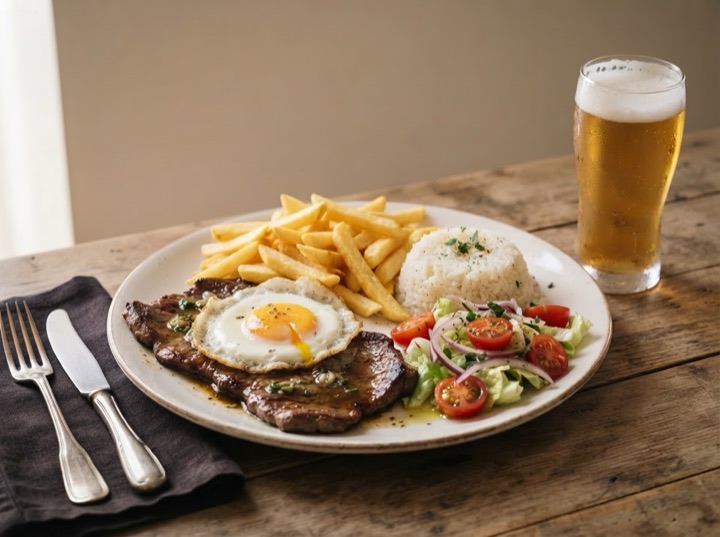
BitoquePortuguese Steak with a Fried Egg
The café classic: thin steak seared in garlic and bay, a quick beer pan sauce, a fried egg on top, chips, rice and salad. Portugal's favourite everyday plate.
 Traditional
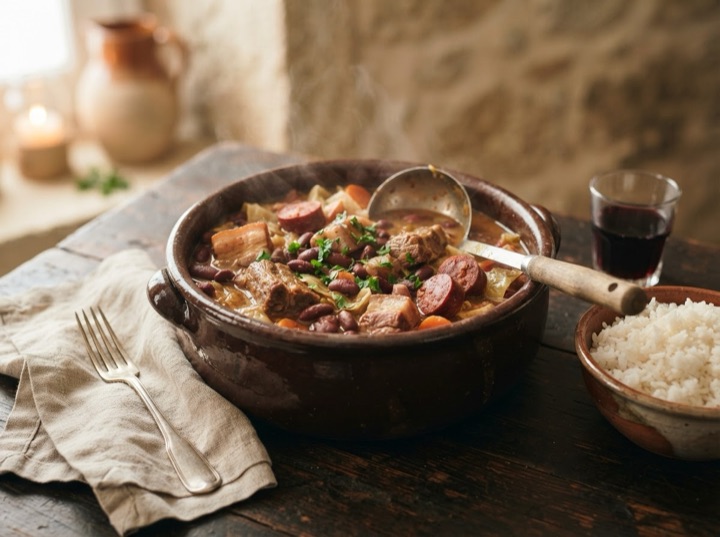
Feijoada à TransmontanaBean and Pork Stew
Red beans slow-cooked with pork, chouriço, cabbage and carrots, the hearty winter stew of Trás-os-Montes. A home version that skips the hard-to-find cuts.
 Food culture
Why Do Portuguese Eat BacalhauThe Story of the Faithful Friend
Why do Portuguese eat bacalhau when no cod swims off Portugal? Salt, Catholic fasting, Newfoundland fleets and the Estado Novo, explained simply.